Get Orbit free acount only for today, and get your money with refferal code

July 16, 2026
How to Change SIL Providers: A Step-by-Step Guide (2026)
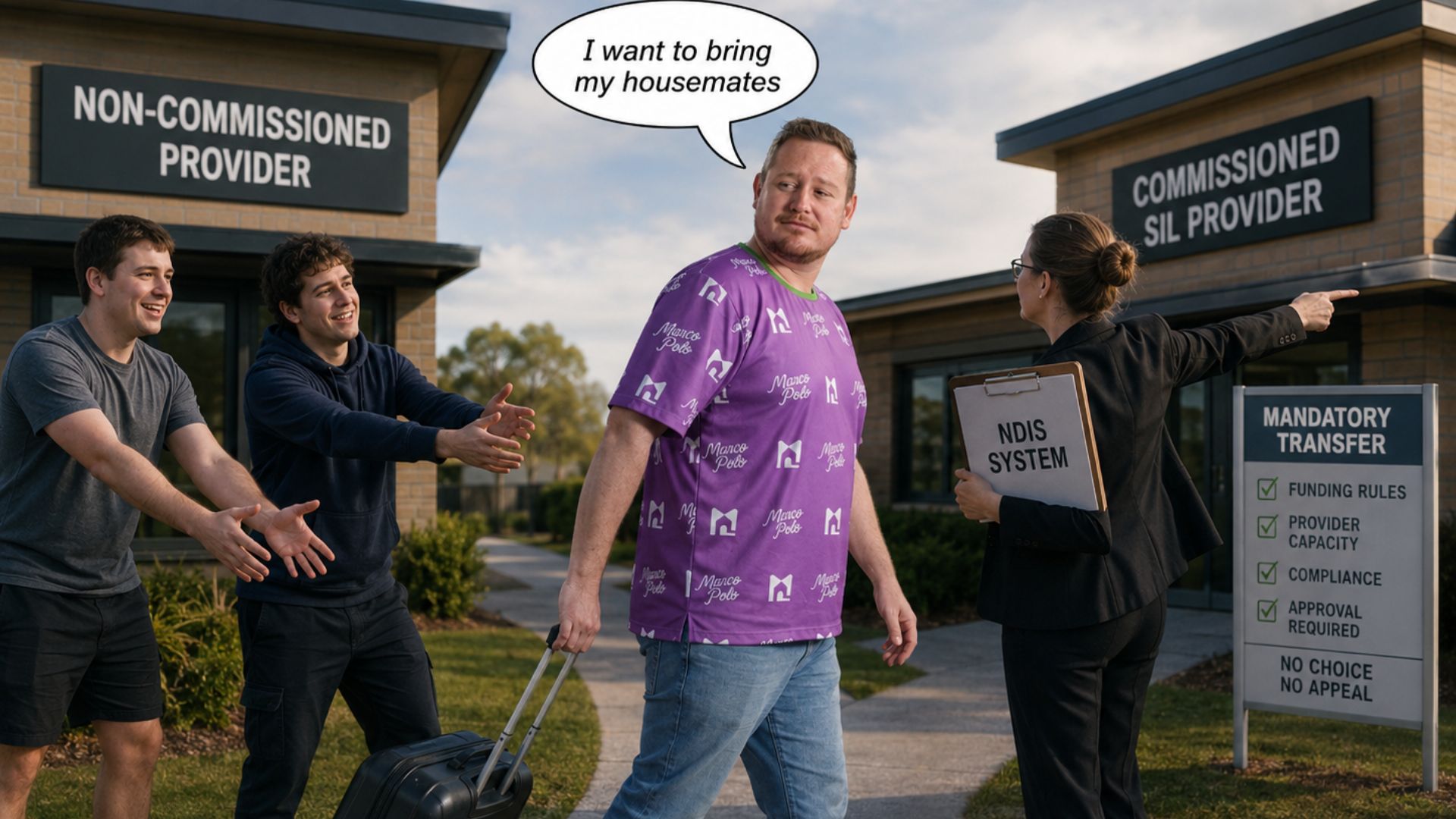
Yes, you can change SIL providers, and your NDIS funding moves with you. The key is to plan the move properly rather than jump into the next available vacancy. This guide walks you through six practical steps: diagnose the issue, plan with independent advice, match your housemates rather than fill a vacancy, do due diligence on the new provider, read the service agreements, and execute the move cleanly. It also covers why you may end up having to move anyway as SIL commissioning lands and group home models are wound back.
This article is for participants and families changing SIL providers, or thinking about it. It's deliberately step-by-step. The other articles in this cluster handle the emotional and structural questions in more depth, so here we get straight into the mechanics of doing it well.
Let me start with a quick story
A bloke called me last year, six weeks into a SIL move he'd done in a hurry. He'd had a falling-out with his old provider, given two weeks' notice, and accepted the first house another provider had on offer. The room was small, the housemates didn't fit, the workers weren't trained properly, and he was already wishing he hadn't left.
He asked me what to do. The honest answer was that the second move had to be done properly, and the time to plan it was now. The first move had been a reaction. The second move had to be a decision.
The hard part is doing it deliberately enough that the new home is better than the old one, not just different.
Step 1: Diagnose whether your current SIL is actually the problem
Before you move, be honest about what's wrong. The fix is completely different depending on what kind of problem this is.
A SIL situation can be poor for a few different reasons:
- Provider behaviour. Unreliable rostering, untrained workers, communication breakdowns, poor incident response, money flows you can't account for.
- Housemate mismatch. Compatible people, wrong combination. Or compatible on paper, incompatible in practice.
- House-specific issues. Location, building, layout, neighbourhood. Sometimes the bricks and mortar are the problem.
- Vertical integration issues. Your SIL provider, your coordinator, and community access provider all belong to the same corporate group. You're stuck inside one company's pipeline and the "choices" you've been offered aren't really independent.
If the problem is the provider specifically (workers, rostering, incident response, finance), changing provider can fix it. If the problem is the housemates, sometimes a housemate change inside the existing SIL is enough. If the problem is vertical integration, changing provider alone won't fix it either; you need to break out of the closed system, which means changing your coordinator first.
Write down the actual issues, with specifics. Dates, examples, what was said, what wasn't done. Two reasons. First, it forces you to be honest about whether the issues warrant a move. Second, you'll need a record when you're explaining the move to the new provider, the NDIA, and (if it gets to that) the NDIS Quality and Safeguards Commission.
If safety is involved (directed harm, neglect, or anything that breaches the NDIS Code of Conduct), skip ahead. Document, report to the Commission on 1800 035 544, and get yourself safe before you worry about the orderly move.
Step 2: Start planning early, and clear the conflicts of interest first
The biggest mistake people make at this stage is planning the move inside the same system that's causing the problem. If your support coordinator works for the same organisation as your current SIL provider, they have a structural conflict of interest. If your coordinator is going to suggest a new provider, you need to know that the suggestion is in your interests, not theirs.
The first practical move is to switch to a genuinely independent support coordinator. Independent meaning:
- Not employed by your current SIL provider.
- Not employed by your prospective new SIL provider.
- Not part of the same corporate group as either.
- Not receiving referral fees or sharing ownership with either. ( this still happens )
Ask the question directly when you're interviewing coordinators. "Is your employer owned by, or affiliated with, [provider name]?" Read the ownership disclosures on company websites. Check ABN records if you want certainty. If the answer is yes, keep looking.
Once you've got an independent coordinator on board, plan the move with them, not with anyone connected to the providers in question. The change of coordinator is free, it doesn't draw down your support budget any differently, and it's one of the easiest single moves you can make to put real Choice and Control back into your hands.
This is also the stage to bring in other independent voices. An independent disability advocate (funded through the National Disability Advocacy Program and findable via Ask Izzy) can sit with you and help you think through whether a move is the right call. A Community Visitor, if one already attends your current SIL through your state's Public Advocate or Public Guardian, can also be a useful sounding board. Build a circle of advisors who don't work for any provider in your situation.
Step 3: Don't jump into the next available SIL. Match housemates first.
This is the single most important step, and the one most people skip.
The standard pattern when participants change SIL providers is that the new provider offers a vacancy in one of their existing houses, the participant moves in, and the match is made on the basis of "we had a bed." That's exactly the same logic that probably caused the original problem. Replicating it just gives you a fresh version of the same trouble.
A house works because the people in it fit. The room, the rent, the location, even the support arrangement matter less than the question of who you're sharing your life with. Matching housemates first, and then approaching a provider as a pre-formed group, flips the entire model. You're not asking "where are the vacancies?" You're asking "who do I want to live with, and which provider can support us in a house we choose?"
Practical ways to do this:
- Marco Polo Portal. Designed for participants, by people with disabilities, specifically to match housemates outside any provider's commercial pipeline. You build a profile, you see other participants' profiles, and you start conversations with people who might actually fit before any provider gets involved.
- Existing networks. Day programs, supported employment, sports and recreation groups, faith communities, school or therapy connections. People who already know each other often make the best housemates because the matching is real-world, not algorithmic.
- Family and friends-of-friends. Sometimes the right housemate has been at the family Christmas for twenty years. Don't dismiss the obvious connections just because they're close to home.
Once you've got one or two potential housemates identified, spend time together before committing. Coffees, meals, weekends away if possible. Six conversations beat a single meet-and-greet every time. You're checking compatibility, communication styles, daily rhythms, what each of you wants out of the arrangement.
This step takes weeks or months, not days. That's the point. Slow matching now prevents another fast move six months from now.
Step 4: Do real due diligence on the new provider
Once you've got tentative housemates, look at providers properly. Not the first one your old coordinator mentioned, and not the first one with a vacancy. Build a shortlist of three or four and interrogate each.
Questions worth asking every prospective provider:
- Are you registered with the NDIS Quality and Safeguards Commission? (From 1 July 2026, this is mandatory for SIL providers anyway). Any provider not registered or actively pursuing registration is a red flag.)
- Who owns you? What other entities are in your corporate group? Specifically, do you share ownership with any support coordination services or other NDIS services I might be referred to?
- Can I see a sample service agreement before I commit?
- What's your notice period for a participant leaving?
- How do you handle housemate disputes? What's an example of a recent one and how did it resolve?
- Can I speak to two or three families of current participants?
- What's your behaviour support and incident management approach?
- How are your workers trained and rostered, what happens when someone calls in sick?
- What proportion of your DSP and CRA arrangement covers what?
A good provider will answer these openly. A provider who deflects, gives vague answers, or pressures you to commit before answering is telling you what their behaviour will look like once you're a participant. Trust that signal.
Step 5: Read the service agreements before you sign anything
This is the step where participants get quietly trapped, and it's the step nobody slows down for.
The service agreement is a contract between you and the provider. It sets out:
- Notice periods (often two to four weeks, sometimes longer; some providers try for 90 days).
- Exit fees and conditions.
- What services are included and excluded.
- Charges for absences and holidays.
- Money flows for DSP and CRA, and how they're calculated against the actual cost of the house.
- Dispute resolution processes.
- What happens to your belongings if you leave.
- What are some of the other inclusions not covered by the NDIS
Read the document slowly. Read it twice. Get your independent coordinator to read it. Get an advocate to read it if you can. Ask for changes if anything looks unreasonable. Service agreements are negotiable, and providers who refuse to negotiate any clause are telling you what the rest of the relationship will be like.
Specific things to look for and push back on:
- Notice periods over 30 days. They're not standard and they're not in your interests.
- Fees for "early termination" that exceed actual provider costs.
- Vague clauses that let the provider change house rules unilaterally.
- DSP and CRA arrangements where the provider draws down everything and accounts back for nothing.
- Restrictions on who you can visit, when, and where, that aren't agreed upon with other housemates.
- Clauses that make any complaint subject to provider-controlled processes before you can escalate to the NDIS Commission.
If you spot any of these, push back in writing. If they won't move, that tells you what you need to know.
Also remember: the service agreement covers your support delivery. If you're moving into a provider-owned house, there may be a separate residency or licence agreement covering your tenure in the building. Read that too. The two documents together describe the totality of the relationship.
Step 6: Execute the move cleanly
Once the new provider is locked in, housemates are tentative, and agreements are signed, the move itself is straightforward if you sequence it carefully.
Order of operations:
- Confirm the new start date with the new provider in writing.
- Give written notice to your current provider, referencing the notice period in your existing service agreement.
- Coordinate the DSP and CRA handover so you're not paying two providers for the same period. Talk to Services Australia early if you need to redirect payments.
- Under PACE, formally endorse your new provider in the NDIS portal and remove the old one.
- Arrange your belongings to move on the right day, not before. Some participants make the mistake of moving their stuff out early as a signal and end up sleeping in a half-empty room for two weeks.
- Confirm the worker handover. Where possible, have a workers' meeting between the old and new teams so support routines, medication regimes, and behavioural support plans transfer with you.
- Schedule a 30-day, 90-day, and 6-month review with your independent coordinator to check how the new arrangement is bedding in.
If the move is fraught (the old provider isn't cooperating, the new provider is changing terms, the DSP and CRA handover is messy), that's where your independent coordinator earns their keep. Make them work the problem.
The bigger picture: you may end up moving anyway
This is the part to read carefully even if your current SIL is fine.
Two regulatory changes are reshaping the SIL market over the next few years, and both will affect where you live regardless of how well your current setup is working.
SIL commissioning. In April 2026, the Minister for the NDIS announced that the Government will design and commission a new model for home and living supports for SIL participants who need 24/7 support. Consultation begins July 2026, and the new commissioned support coordination function is scheduled to begin from 1 July 2028. The Minister has indicated that participants will still be able to choose their SIL provider, but only from a Government-vetted list. In practice, that means the SIL market is going to consolidate. Providers who don't make the vetted list won't be able to deliver SIL. If your current provider is one of them, you'll be moving whether you want to or not. The participants who plan for this now will have far more control over where they end up than those who wait.
Mandatory SIL registration. From 1 July 2026, every SIL provider in Australia must be registered with the NDIS Quality and Safeguards Commission. Some smaller providers won't make the deadline. Some will exit the SIL market entirely. Participants with unregistered providers who don't transition before the deadline risk a forced, urgent move under exactly the wrong conditions. If you don't know whether your provider is on track for registration, ask them, in writing, this week.
The phase-out direction on group homes. The Disability Royal Commission recommended phasing out group homes, with one set of Commissioners proposing a 15-year roadmap and another proposing a generational timeframe with interim measures. Governments haven't yet committed to a formal phase-out roadmap, but the direction of travel is unambiguous. The interim measures already in motion include no new four-to-six-bedroom group home models being approved for SDA, and new participants only entering group home accommodation as a last resort. Existing residents are increasingly being prioritised for moves to smaller, more independent arrangements on request.
Equally important is what the Commission called out as "third line forcing," which is when a single organisation acts as both landlord and support provider in a group home. This is the regulatory term for the vertical integration we keep flagging. Reform is coming for this practice. Participants currently in arrangements where one corporate group owns the building, employs the workers, and runs the coordination are sitting in a model the regulator is openly preparing to dismantle.
The honest read of all this is that the SIL market in 2028 will look meaningfully different from the SIL market in 2026. Fewer providers, more registration, more separation of housing and support, fewer large group homes, and a stronger push toward genuinely independent matching. Participants who plan their move now, with real choice and the right third parties in their corner, will be on the right side of those changes. Participants who wait may find the system moves them whether they're ready or not.
Honest Pros and Cons of changing SIL providers
Pros
- You get out of a setup that isn't working without being trapped by inertia.
- Your NDIS funding moves with you. You're not financially penalised for exercising Choice and Control.
- Done deliberately, the second placement can be dramatically better than the first.
- You preserve real choice ahead of upcoming commissioning and registration changes.
Cons
- The move takes weeks if not months of planning to do well.
- Your DSP and CRA arrangements need careful coordination during the handover.
- If you rush, you risk landing in another setup with the same problems.
- The other housemates in your current house may be affected by your move, including the possibility of the house no longer being viable for the provider to run.
The Mistakes I See Most Often
- Jumping into the first available bed. It's the same logic that caused the first problem. Don't repeat it.
- Keeping the same coordinator who works for the old or new provider. Get an independent one before you do anything else.
- Skipping the housemate-matching step. A new house with the wrong housemates is the next problem, not the solution.
- Signing the new service agreement without reading it. Service agreements are negotiable. Push back.
- Forgetting to coordinate the DSP and CRA handover. This is where money goes missing in the gap between providers.
- Not asking about provider registration. From 1 July 2026, unregistered SIL providers can't operate. Confirm now.
- Not asking about ownership. Vertically integrated providers are a known regulatory target. Don't move from one closed system into another.
- Waiting until the system forces the move. Commissioning, registration, and group home reform are all coming. Plan ahead of them, not behind them.
Frequently Asked Questions
Will my NDIS funding follow me to the new SIL provider?
Yes. Your SIL funding belongs to you, not the provider. Under PACE, you formally endorse the new provider in the NDIS app or portal and the old one is removed. Your support coordinator can walk you through the steps.
How long does changing SIL provider usually take?
From decision to move-in, anywhere from six weeks to several months. The bottleneck is usually housemate matching and provider availability, not paperwork. Faster is possible if the new provider has a suitable house already. Slower is usually better.
Do I lose my SIL approval if I change providers?
No. SIL is approved in your plan based on your support needs, not the specific provider. The approval travels with you.
What if my current provider tries to charge me an exit fee?
Check your service agreement. Standard notice periods are two to four weeks and typical agreements don't include exit fees beyond covering work already done. Anything beyond that is worth pushing back on, and if the provider won't negotiate, raise it with the NDIS Quality and Safeguards Commission.
What if the only vacancies on offer are in vertically integrated providers?
Then keep looking. Use Marco Polo Portal to find housemates outside any one provider's pipeline. Source your own potential housemates from your existing networks. The point of a deliberate move is to avoid replacing one closed system with another.
Can I change SIL provider without changing house if I'm in SDA?
Sometimes yes. If your SDA tenure is with a different entity than your SIL provider, you can keep the SDA dwelling and change just the SIL provider. This is one of the most underused options in the SDA market and worth exploring before assuming a move means changing house.
What happens to my old housemates when I leave?
They stay, but the provider may need to find another participant to keep the house viable, or the house may close if the ratios no longer work. This is worth considering as you plan, although it's not a reason to stay in a setup that isn't working for you. Your home is yours to leave.
What if SIL commissioning means my preferred new provider won't be on the vetted list?
That's a live risk. Until the commissioning model is finalised through the consultation that begins July 2026, nobody can be certain which providers will make the list. Reasonable due diligence right now includes asking prospective providers what they're doing to prepare for commissioning and what their plan looks like if they don't make the vetted list.
Should I wait for commissioning to settle before I move?
Generally, no. If your current arrangement isn't working, waiting could mean two more years of a bad setup. Moving now, with the right third parties involved, gives you control over where you end up. The participants who wait risk having the system move them under worse conditions.
Will group homes really be abolished?
Not yet, but the direction of travel is clear. The Disability Royal Commission recommended phasing them out, governments are still working through their formal response, and interim measures are already in motion (no new four-to-six-bedroom group home SDA, new participants only entering group homes "as a last resort"). The expected reform of "third line forcing" (one organisation as both landlord and support provider) will reshape the SIL market regardless of the broader phase-out timeline.
Your home. Your housemates. Your call.
Changing SIL providers isn't complicated, but it has to be deliberate. The mistake that turns one bad placement into two is doing the second move with the same logic that caused the first one. Match housemates before you match houses. Get independent advice before you commit. Read the agreements before you sign. Move on your timeline, not someone else's.
If you're a participant or family member planning a SIL change, signing up to Marco Polo Portal is great and lets you find compatible housemates outside any provider's commercial pipeline before you approach a new provider. If you're a support coordinator helping a client navigate a change, our coordinator page has the tools to make the work easier and reduce conflicts of interest in your own practice. And if you're a SIL or ILO provider who'd rather welcome pre-formed groups than fill vacancies with placement-driven matches, our provider page is built for you.
Your home. Your housemates. Your call. Always.
About the Author


Aaron Cotton
Aaron Cotton didn't set out to work in disability housing, he was a pharmacist who stumbled into a system so broken he couldn't look away. What he found was simple and unacceptable: people with disability are often denied a choice most of us take for granted, like who they get to live with.
So he set out to fix it. Aaron co-founded Marco Polo Portal, a platform that gives that choice back, after building Acorn Homes, a Supported Independent Living provider grounded in the same idea, not just talking about empowerment, but actually handing people control. His work has earned the Innovation Award at the Disability Leadership Institute and a place in Remarkable Tech's accelerator.
Aaron is a QDN Engage Consultant and a council member with the NDIS Quality and Safeguards Commission, but for him the real driver has always been community impact: real people having real choice. A straight-talker by nature, he writes for anyone ready to reimagine what disability housing can, and should, look like.


.png)


Join our newsletter to stay up to date on features and releases.

Marco Polo acknowledges the Traditional Owners and Custodians of Country throughout Australia and recognizes their enduring connection to land, waters, and community. We pay our respects to Elders past, present, and emerging and extend that respect to all First Nations people.
We acknowledge that First Nations people experience disability at a higher rate and face unique challenges within the disability sector. We are committed to listening, learning, and working collaboratively with First Nations communities to support inclusive, culturally respectful services that honor Indigenous values of family, community, and shared care.