Get Orbit free acount only for today, and get your money with refferal code

July 16, 2026
Group Homes vs SIL: What's the Real Difference?
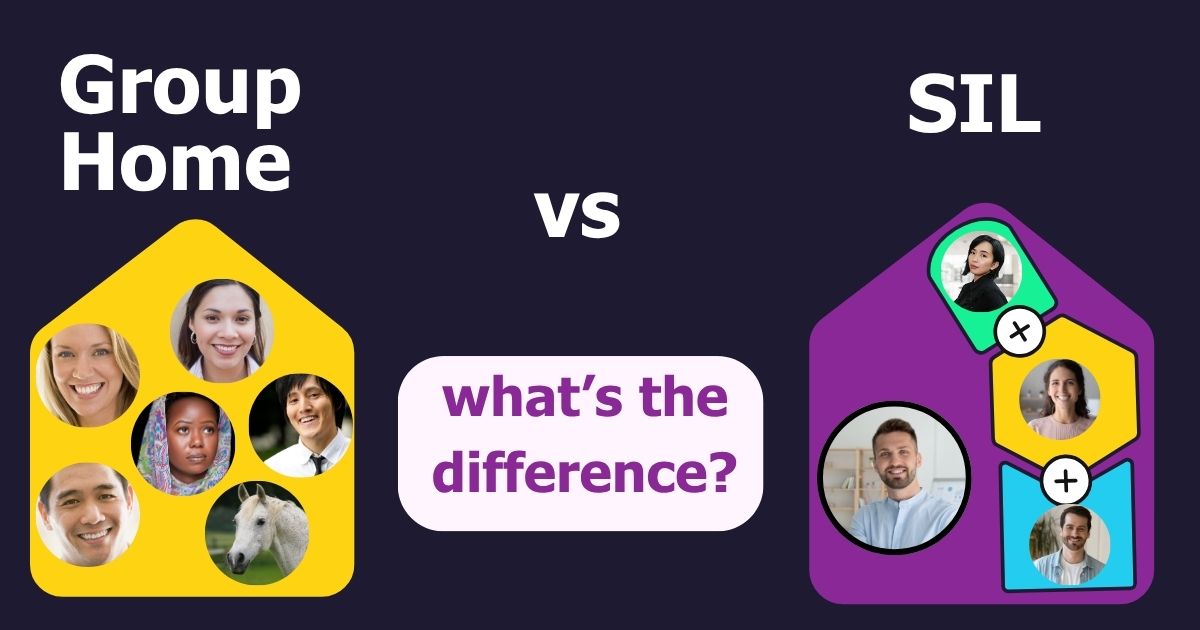
Here's the part that surprises people: a traditional group home is a type of SIL. They're not opposites. The real difference isn't the funding label, it's who's in control. A group home is usually a provider-run, multi-occupant house where the provider chooses the residents, sets the rules, and fills the beds. A participant-led SIL arrangement is one where you and people you've chosen decide who lives together and how. Same funding, completely different lives. This guide explains the real distinction, and why it almost always comes back to control.
The first time I moved out of home, the house was a mess. Four of us, a rented place near uni, a fridge that was mostly other people's food I wasn't supposed to touch and definitely did, and an ongoing argument about whose turn it was to deal with the bins that I don't think we ever actually resolved. One of my housemates worked nights and slept through the day. Another one cooked enough food for six people every Sunday and we all benefited. It was stressful and broke and chaotic and I learned how to budget, cook, argue, apologise, and live alongside people who weren't my family, all at once, by doing it badly and then slightly less badly.
I think about that a lot when I hear how we house people with disability, because almost nobody offers them that version of moving out. The messy share house with mates. The uni-years chaos. The figuring-it-out-together that most of us got handed as a rite of passage. For people with disability, "moving out" usually means being assessed, quoted, and placed into a house full of strangers chosen by a provider, with the rules already written. The formative bit, the part where you live with people you picked and grow because of it, gets quietly removed and replaced with a managed setting. And we tell ourselves that's care.
That's the thing I want to pull apart in this article, because the group home versus SIL question is really a question about who gets to have that experience, and who gets it taken away.
Clearing up the confusion: a group home is a kind of SIL
Let's fix the terminology, because it trips up almost everyone.
SIL (Supported Independent Living) is the NDIS funding for support workers who help you in your home. It is not a building, not a house type, not a place. It's funding for support.
A "group home" is not an NDIS funding category at all. It's a description of a kind of housing: a shared house, usually with three to six residents who have disability, run by a provider, where support is delivered. The support in a group home is funded through SIL.
So a traditional group home is a setting in which SIL is delivered. They're not two options on a menu. One is funding, the other is a type of house. When someone asks "group home or SIL?", the accurate answer is "a group home is one way SIL can be delivered, and there are others."
That matters, because once you see that the funding is the same either way, the real question comes into focus. It was never "which funding?" It's "who controls the home, and who chose the people in it?"
Drop the picture in your head of what a group home looks like
When people hear "group home," they picture a particular thing: a tired old state-run house, beige and a bit institutional, the kind of place that smells faintly of disinfectant, with a Barbara on staff who's been there since before anyone can remember and runs the place the way it's always been run. Entrenched, weary, well past its use-by date.
Those places exist, and they're as grim as you're imagining. But here's the uncomfortable update: a brand-new, freshly painted, architect-designed SIL house can be exactly as institutional as the worst old group home. The building being modern doesn't change the culture inside it. If a provider chose the residents, owns the house, sets the rules, and runs it for the convenience of the roster, then it's a group home in everything but appearance, no matter how nice the kitchen splashback is.
Plenty of modern SILs have, frankly, earned the label "group home" in the worst sense. New paint, same control. A mini-institution with good lighting. So when you're weighing up a place, don't be reassured by how it looks. Ask how it's run and who decides things. The institution is in the control structure, not the carpet.
The real difference: who is in control
This isn't just my opinion. The Grattan Institute's 2024 report on NDIS housing, "Better, Safer, More Sustainable," landed on the same point. Their analysis found that the problem with group homes isn't the economy of scale of sharing supports, which is actually sensible and can save billions across the roughly 7% of participants who use intensive housing and support (a group that accounts for around 37% of total scheme spend). The problem is the institutional culture, and the high rates of violence and abuse in these settings. And they pinpointed where that institutional culture comes from: arrangements where one disability organisation controls both the housing and the support, the whole lot, under one roof.
If you want to understand how those shared ratios actually translate into dollars, we break the numbers down in our guide to what SIL really costs.
That's the heart of it. Strip away the labels and every meaningful difference between a "group home" and a good participant-led SIL arrangement comes down to control.
In a traditional group home, the provider holds the control. They own or head-lease the house. They choose who fills the vacancies. They set the house rules, the routines, the staffing model and the ratio. Residents are matched to a ratio or funding amount rather than to each other. You move into their house, on their terms, with people they selected. Your "choice" is usually limited to saying yes or no to a placement.
In a participant-led SIL arrangement, you hold the control. You and the people you've chosen decide who lives together. You pick the house, or at least have a real say in it. The support is delivered around your lives rather than your lives being arranged around the support. The provider works for you, in your home, instead of you being slotted into theirs.
This is why two houses with identical SIL funding, identical ratios, and identical support hours can produce completely different lives. One is a place you were put. The other is a home you made.
Institutional culture can happen in a house of one
Here's a point the Grattan report and others working in this space have made that genuinely reframes things: institutionalisation isn't about how many people live in the house. You can have an institutionalised home with a single participant in it.
That sounds counterintuitive, because we associate "institution" with size, with wards and dormitories and lots of people. But the institutional quality is about the culture. A person living alone, in their own unit, can still be living an institutional life if a provider controls their routines, decides their schedule, restricts their choices, manages their access to their own kitchen, and runs their day for the convenience of the service rather than the life of the person. One participant, one flat, fully institutionalised.
The flip side is the hopeful bit. A house with three or four people in it can be the least institutional place imaginable if the people living there are in control of it. Numbers don't determine it. Control does. This is why "just give everyone their own place" isn't automatically the answer, and why a well-run shared home can be more liberating than a poorly-run solo one.
The entrenched ableism
There's a harder truth running underneath a lot of this.
A surprising amount of the "group home is safer and more appropriate" thinking is built on low expectations of people with disability. The assumption that participants can't choose their own housemates, can't run their own household, can't handle visitors or cook their own meals or manage a normal adult life, is ableism, even when it comes dressed as care and concern.
You hear it in the language. "We'll place her somewhere suitable." "He needs to be in a setting where everything's managed." "It's safer if the provider handles all that." Sometimes those statements are true for a specific person's specific needs. Often they're a default applied to everyone, regardless of capacity, because the provider finds it easier to manage people than to support choices.
It's the same low expectation that decides a person with disability doesn't get the messy share-house years. Nobody sits down and decides to deny someone the experience of living with mates and growing up through it. It just never gets offered, because the assumption underneath is that this person needs managing, not a normal life with normal mess in it.
The case against defaulting to living alone
The natural reaction to a bad group home is "then I'll just live alone." Slow down on that, because living alone carries its own serious risk, and the data on loneliness is sobering.
Loneliness is common in Australia, and it's harmful. The Australian Bureau of Statistics reports around one in six Australians often feel lonely, and broader surveys put the share who feel lonely at least some of the time at more than a third. This isn't a soft problem either: loneliness has been linked to premature death, poorer physical and mental health, and greater psychological distress.
For people with disability, it's markedly worse. Australian longitudinal research using two decades of HILDA survey data found people with disability were 1.5 to 1.9 times more likely to experience loneliness than people without disability, and that disadvantage persisted across the whole period without improving. The gap was widest for people with intellectual or learning disabilities, psychological disability, and brain injury or stroke.
So the reaction to a controlling group home shouldn't automatically be "live alone." For a sociable person, putting them in a flat by themselves with a few drop-in hours a week can be a fast track to exactly the isolation the data warns about. The answer to a bad shared home isn't necessarily no shared home. It's a shared home you control, with people you chose. Which, funnily enough, is what most of us wanted when we moved out the first time.
So the answer isn't "group home or alone." It's "who's in control."
Put the pieces together and the real choice reframes itself.
The traditional group home gives you company but takes your control. Living alone gives you control but risks your connection. Both are real trade-offs, and both are the options the system tends to put in front of you.
But there's a third option the "group home vs alone" framing hides: chosen co-living, where you control the home and you live with people you actually like. That's participant-led SIL, or drop-in shared living, or an ILO arrangement built around housemates you've chosen. It gives you the connection that protects against loneliness and the control that protects against institutional drift. The messy-share-house experience, adapted, with support wrapped around it instead of running it.
This is the whole reason platforms like Marco Polo Portal exist: to help participants find compatible housemates first, then approach providers as a chosen group, so the home is led by the people living in it rather than by the provider filling beds.
Honest Pros and Cons
Traditional provider-run group home
Pros: a place is organised for you, support is on-site and usually 24/7, you're not alone, and it can be quicker to access because the beds already exist.
Cons: you don't choose your housemates, the provider controls the rules and routines, institutional practices creep in regardless of how new the building is, your flexibility is low, and a poor housemate match is something you live with rather than change.
Living alone with drop-in support
Pros: maximum control over your own space, your own rules, complete privacy, support that comes to you on your terms.
Cons: real and serious loneliness risk, less support on hand if something goes wrong, the full weight of running a household alone, and the possibility of an institutional life even in a place of your own if a provider controls your days.
Participant-led chosen co-living
Pros: you control the home and choose the people, you get the health-protective benefits of connection, support is built around your lives, and when something isn't working you can change it because it's yours.
Cons: it takes more upfront work to find compatible housemates and set up, it can take longer than accepting a ready-made vacancy, and it asks you to lead rather than be placed, which not everyone feels ready for at first.
And if a placement does go wrong, getting out is harder than it should be, which we cover in what to do when an NDIS housemate isn't working out.
How to choose well
Don't be reassured by a nice building. Institutional culture lives in the control structure, not the fittings.
Don't accept "group home" as the automatic answer just because the beds exist now. The quick option and the right option are often different.
Don't swing to living alone as a reaction to a bad group home. Check it honestly against the loneliness risk, especially for someone sociable or already isolated.
Notice the low expectations. If the reasons for the most controlled option are really about someone assuming what the person can't do, question them.
Start early so chosen co-living is genuinely on the table. People end up in provider vacancies mostly because they left it too late to build something better.
Get an independent support coordinator who isn't tied to a group home provider, so the advice isn't quietly steering you toward someone's empty bed.
Frequently Asked Questions
Is a group home the same as SIL?Not exactly. SIL is the NDIS funding for support workers in your home. A group home is a type of shared housing, usually provider-run with several residents, where that support is delivered. So a group home is one setting in which SIL is provided, not a separate funding type. The funding can be identical to a participant-led arrangement; what differs is who controls the home.
What is the real difference between a group home and a participant-led SIL home?
Control. In a group home, the provider owns or runs the house, chooses the residents, and sets the rules. In a participant-led arrangement, you and the people you have chosen decide who lives together and how the home runs, with the provider delivering support into your home. The Grattan Institute identified that institutional culture comes from one organisation controlling both housing and support.
Can a brand-new SIL house still be institutional?
Yes. Institutional culture is about control, not the age or appearance of the building. A modern, well-designed SIL house can be just as institutional as an old state-run group home if a provider chose the residents, owns the house, and runs it for the convenience of the roster. Judge a home by how it is run and who decides things, not by how it looks.
Can living alone still be institutional?
Surprisingly, yes. Institutionalisation is about the culture and the control, not the number of people in the house. A person living alone can still lead an institutional life if a provider controls their routines, schedule, and choices and runs their day for the service rather than the person. A shared home where the residents are in control can be far less institutional than a controlled home of one.
Are group homes being phased out?
The direction of travel is away from them. The Disability Royal Commission recommended phasing out group homes, and interim measures are already in motion, including no new four-to-six-bedroom group home models for SDA and new participants only entering group homes as a last resort. Governments have not committed to a full phase-out timeline yet, but the momentum is clearly toward smaller, participant-led options.
Is it better to live alone than in a group home?
Not automatically. Living alone gives you control, but it carries a real loneliness risk. People with disability are 1.5 to 1.9 times more likely to experience loneliness than people without, and that gap has not improved in two decades. For sociable people, chosen co-living with housemates you like is often better for your health and wellbeing than living alone.
Can I choose my own housemates instead of being placed in a group home?
Yes. You can find compatible housemates yourself and approach a provider as a pre-formed group, rather than being placed into a vacancy. This is participant-led SIL, and it gives you the connection of shared living with the control of choosing who you live with. Starting early is key, because it takes longer than accepting a ready-made placement.
How do I avoid an institutional environment?
Ask who controls the home, who chose the residents, and who sets the rules. Watch for institutional practices like curfews, locked cupboards, and routines built around staff convenience, and do not be reassured by a new building. Aim for a home you and chosen housemates control, get an independent support coordinator not tied to a group home provider, and start the search early.
Your home. Your housemates. Your call.
The group home versus SIL question turns out to be the wrong question. They aren't opposites, and the funding is often identical. The real question is who's in control: a provider filling beds in a house they run, or you and people you've chosen building a home together. Most of us got the messy, formative, sometimes-broke experience of moving out with people we picked. People with disability deserve that same shot at a real home, not a managed setting dressed up as care.
If you want to find compatible housemates and lead your own living arrangement rather than be placed into a provider's vacancy, Marco Polo Portal is built for exactly that. It's $97 a year for participants, non-renewing, and usually claimable through your NDIS plan. If you're a support coordinator helping clients avoid institutional placements and build chosen co-living, our coordinator page has the tools. And if you're a SIL provider who'd rather support participant-led, well-matched homes than run institutional group houses, our provider page is built for you.
Your home. Your housemates. Your call. Always.
About the Author


Aaron Cotton
Aaron Cotton didn't set out to work in disability housing, he was a pharmacist who stumbled into a system so broken he couldn't look away. What he found was simple and unacceptable: people with disability are often denied a choice most of us take for granted, like who they get to live with.
So he set out to fix it. Aaron co-founded Marco Polo Portal, a platform that gives that choice back, after building Acorn Homes, a Supported Independent Living provider grounded in the same idea, not just talking about empowerment, but actually handing people control. His work has earned the Innovation Award at the Disability Leadership Institute and a place in Remarkable Tech's accelerator.
Aaron is a QDN Engage Consultant and a council member with the NDIS Quality and Safeguards Commission, but for him the real driver has always been community impact: real people having real choice. A straight-talker by nature, he writes for anyone ready to reimagine what disability housing can, and should, look like.


.png)


Join our newsletter to stay up to date on features and releases.

Marco Polo acknowledges the Traditional Owners and Custodians of Country throughout Australia and recognizes their enduring connection to land, waters, and community. We pay our respects to Elders past, present, and emerging and extend that respect to all First Nations people.
We acknowledge that First Nations people experience disability at a higher rate and face unique challenges within the disability sector. We are committed to listening, learning, and working collaboratively with First Nations communities to support inclusive, culturally respectful services that honor Indigenous values of family, community, and shared care.