Get Orbit free acount only for today, and get your money with refferal code

July 16, 2026
Peer Mentors vs Support Coordinators: 2026 Guide
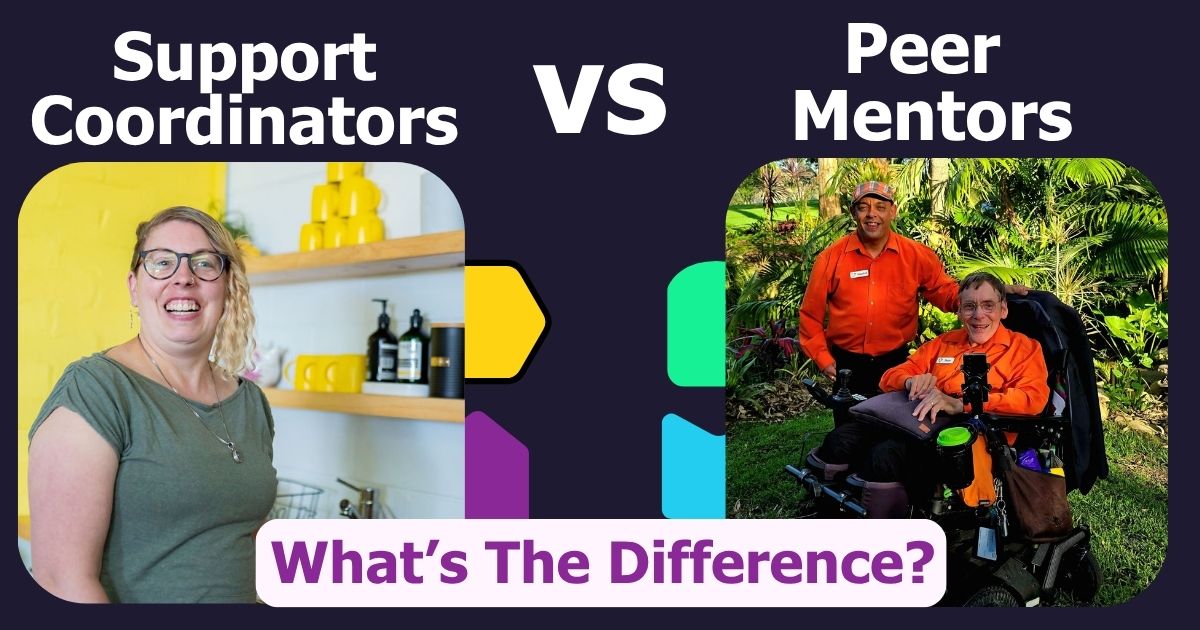
A support coordinator is a funded professional who organises your NDIS supports: finding providers, managing your plan logistics, and connecting services. A peer mentor is someone with lived experience of disability who walks alongside you, sharing what they've learned from living it. The big shift in 2026 is that the two are heading in opposite directions. Support coordination is being squeezed and, from July 2028, removed from individual plans entirely. Peer support is being recognised and funded in new ways. This guide explains both roles, how each is funded, and why lived experience is becoming the thing that matters most.
This article is for NDIS participants and families trying to understand the difference between a peer mentor and a support coordinator, and which one actually helps with what. We'll cover what each role does, how they're funded (and how that's changing fast), the lived-experience gap that sits at the heart of the difference, and what the 2026-2028 reforms mean for how you'll get help navigating the system. By the end you'll understand why peer mentoring is on the rise just as traditional coordination is being wound back.
A quick, honest disclosure before we start: we're building a peer mentor network at Marco Polo, so we have a stake in this. But the reforms we describe are real and verifiable, and we've linked the sources. Read it, check it, and make up your own mind.
What a support coordinator actually does
A support coordinator is a paid professional, funded in your NDIS plan, whose job is to help you put your plan into action. In practice that means finding and connecting you with providers, helping you understand your funding, setting up service agreements, resolving issues with providers, and generally making the machinery of your plan work.
There are different levels. Support Connection (Level 1) is light-touch. Coordination of Supports (Level 2) is the common one. Specialist Support Coordination (Level 3) is for participants with complex situations and usually requires a qualified practitioner like a social worker or allied health professional.
A good support coordinator is genuinely valuable. They save you hours of phone tag with providers, they know the system, and they can advocate when something goes wrong.(despite not officially being advocates) The problem isn't that coordinators are bad. Many are excellent. The problem is what's happening to the role itself.
What a peer mentor actually does
A peer mentor is someone who has lived experience of disability, and often of the exact things you're navigating, who supports you by sharing what they've learned. Not from a textbook. From living it.
Where a support coordinator organises your services, a peer mentor helps you understand your options from the inside. They've moved out of the family home. They've changed providers. They've had a housemate situation fall apart and figured out what to do next. They've sat in the planning meeting feeling steamrolled and worked out how to push back. They've made the mistakes, learned the workarounds, and can tell you what nobody else can.
Peer mentoring is less about the paperwork and more about the wisdom. Less "here's a list of providers" and more "here's what I wish someone had told me before I signed that service agreement." It's a fundamentally different kind of help, and for a lot of decisions, especially the big emotional ones like moving out or choosing who to live with, it's the kind that actually changes outcomes.
The lived-experience gap
Here's the difference that sits underneath everything else.
Most support coordinators do not have lived experience of disability. They're trained professionals, often very good ones, but they're working from learned knowledge, not from having walked the path themselves. They can tell you how SIL funding works. They usually can't tell you what it actually feels like to move into a share house with strangers a provider chose, because they've never done it.
Peer mentors work from the opposite direction. Their entire value is that they've been there. The NDIS itself has started to formally recognise this. In the psychosocial recovery coach role, for example, the NDIA explicitly says you might find it helpful to choose someone with lived experience, and it built a whole qualification (the Certificate IV in Mental Health Peer Work) around the idea that having been through it yourself is a genuine, fundable skill.
That recognition matters, because for decades the system treated lived experience as a nice-to-have at best and a liability at worst. The shift toward valuing it, paying for it, and building roles around it is one of the most positive developments in the scheme. People navigating disability are increasingly being helped by people who actually understand disability, not just people who've read about it.
None of this means professional knowledge is worthless. The best outcomes often come from combining both: the coordinator who knows the system and the peer mentor who knows the life. But if the system is going to squeeze one of them out, it's worth asking whether it's squeezing out the right one.
How each role is funded.
This is where it gets important, because the funding is changing fast and it's pushing the two roles in opposite directions.
Support coordination is funded as a specific support in your individual NDIS plan, usually from the Capacity Building budget. Here's the problem: support coordination rates have been frozen since 2019-20. That's six consecutive years with no increase, while every cost around them has risen. The NDIA maintains the rates are sufficient. Providers across the sector say the freeze makes it harder and harder to attract and keep experienced coordinators, which means worse service for participants.
And it gets bigger than a price freeze. Under the reforms in the Securing the NDIS for Future Generations legislation, from 1 July 2028 support coordination will no longer be funded individually in participant plans at all. Instead, the NDIA will directly appoint providers to deliver a new "support coordination and connection service." Providers will apply to deliver it; participants won't have it funded in their own plans the way they do now. On top of that, eligibility for support coordination is already tightening for people who have family or informal support around them.
Put plainly: the traditional, individually-funded support coordinator is being wound back, frozen now and structurally removed by 2028.
Peer support is moving the other way. It can already be funded through your Capacity Building budget, the lived-experience recovery coach being the clearest funded example, sitting at a higher rate than support coordination and explicitly valuing lived experience. But the bigger shift is structural: the NDIA is now funding peer support directly through grants to disability-led organisations, putting up to $20 million a year into community-based, disability-led peer programs as part of building "foundational supports" that sit outside individual plans.
So the two trends are mirror images. The formal, professional, plan-funded role (coordination) is being frozen and removed. The lived-experience, relationship-based role (peer support) is being recognised, funded in new ways, and built into the foundations of the future scheme. If you're wondering where the help is going to come from in a few years, the honest answer is: increasingly, from peers.
How peer support could be funded differently
Because peer mentoring isn't locked to a single funding line the way coordination is, there's genuine flexibility in how it can be paid for. Depending on your situation and your plan, peer support can be accessed through:
Your Capacity Building budget, where lived-experience supports (like recovery coaching for psychosocial disability) are a funded item. Your Core supports in some cases, where peer-led capacity building overlaps with assistance with social and community participation. Through the NDIA's direct grants to disability-led peer organisations, which fund programs you can access without it coming out of your individual plan at all. And through foundational supports, the new tier of supports being designed to sit outside individual NDIS plans and be available more broadly.
That flexibility is part of why peer mentoring is well-positioned for where the scheme is heading. As individual plan funding gets tighter and more standardised, supports that can be delivered at the community and foundational level, rather than line-item by line-item in every plan, are the ones with a future.
So which one do you actually need?
Honestly, often both, for different things. Here's a rough guide.
You need a support coordinator (while they're still funded) when you have genuine system complexity: multiple providers to wrangle, complex funding to manage, service agreements to negotiate, or a crisis that needs someone working the phones. The logistics. The machinery. The stuff that takes system knowledge and billable hours.
You need a peer mentor when you're facing the human decisions: should I move out, who should I live with, how do I handle a housemate situation that's gone wrong, how do I speak up in my planning meeting, what's it actually like on the other side of this choice. The wisdom. The been-there done-that.
A peer who's lived in a provider-run house versus a home they chose can tell you the difference better than anyone, which we also unpack in group homes vs SIL.
The mistake is assuming the coordinator covers both. A coordinator can hand you a list of three SIL providers and what it costs to live with them. A peer mentor can tell you what it was actually like living in one, what to ask before you sign, and how to trust your gut when something feels off. For the decisions that shape your life rather than just your paperwork, lived experience wins.
And given where the funding is going, learning to lean on peer support now, while coordination is still around to handle the logistics, is a sensible way to prepare for a system where the professional coordinator may not be in your plan at all.
Where Marco Polo fits
We'll be upfront: we're building a peer mentor network specifically to help people use Marco Polo and navigate the housing journey, because we think the future of this support is peer-led, not coordinator-led. As traditional coordination gets wound back, the people who've actually found their own housemates, chosen their own homes, and taken control of their living arrangements are the ones best placed to help others do the same.
That's not a knock on coordinators. It's a recognition of where the scheme is going, and a belief that lived experience is the thing that's been undervalued for too long.
Frequently Asked Questions
What is the difference between a peer mentor and a support coordinator?
A support coordinator is a funded professional who organises your NDIS supports, finds providers, and manages your plan logistics. A peer mentor is someone with lived experience of disability who supports you by sharing what they have learned from living it. Coordinators offer system knowledge; peer mentors offer the wisdom of having been there. Many people benefit from both, for different things.
Is support coordination being removed from the NDIS?
In its current form, largely yes. Support coordination rates have been frozen since 2019-20, and under the Securing the NDIS for Future Generations reforms, from 1 July 2028 support coordination will no longer be funded individually in participant plans. The NDIA will instead directly appoint providers to deliver a new support coordination and connection service.
How is a peer mentor funded under the NDIS?
Peer support can be funded through your Capacity Building budget, with the lived-experience recovery coach being the clearest funded example. The NDIA is also funding peer support directly through grants to disability-led organisations, up to $20 million a year, as part of building foundational supports that sit outside individual plans. This flexibility is one reason peer mentoring is growing.
Why does lived experience matter so much?
Most support coordinators work from learned, professional knowledge rather than having navigated disability themselves. A peer mentor has actually lived the things you are facing, like moving out, changing providers, or a housemate situation falling apart. For big personal decisions, that first-hand understanding often changes outcomes in a way a brochure or a provider list cannot.
Can I have both a support coordinator and a peer mentor?
Often yes, and the combination can be powerful. A coordinator handles the system complexity, like wrangling providers and negotiating service agreements, while a peer mentor helps with the human decisions, like who to live with and whether you are ready to move out. They cover different needs, so having both means you get logistics and lived wisdom.
Why are support coordinator rates frozen?
The NDIA has kept Level 2 and Level 3 support coordination rates flat since 2019-20, six consecutive years, saying current rates are sufficient. The sector strongly disagrees, arguing the freeze makes it harder to attract and retain experienced coordinators. The freeze, combined with the removal of individually-funded coordination from 2028, signals the role is being wound back.
What are foundational supports?
Foundational supports are a new tier of supports being designed to sit outside individual NDIS plans and be available more broadly, including some delivered by state and territory governments. Peer support is one of the areas being built into this foundational layer, which is part of why peer mentoring is well-positioned for where the scheme is heading.
Will I still get help navigating NDIS housing without a coordinator?
Yes, but increasingly from different sources. As individually-funded coordination is wound back, peer mentors, disability-led organisations, and platforms built for participants are stepping in. For housing decisions in particular, someone who has actually found their own housemates and chosen their own home is often more useful than a coordinator working from a provider list.
Your home. Your support. Your call.
The difference between a peer mentor and a support coordinator isn't just two job descriptions. It's two different ideas about who should help people with disability: a professional working from learned knowledge, or a peer working from lived experience. For years the system funded the first and undervalued the second. That's changing, fast. Coordination is being frozen and removed; peer support is being recognised and funded in new ways. If you're navigating big decisions, especially about housing, the person who's actually been there is becoming the one to turn to.
If you want to connect with peers who've navigated the housing journey and take control of where and how you live, Marco Polo Portal is built for exactly that. It's $97 a year for participants, non-renewing, and usually claimable through your NDIS plan. If you're a support coordinator wanting to help your clients lead their own housing search, our coordinator page has the tools. And if you're a SIL or ILO provider who'd rather support participant-led, well-matched homes, our provider page is built for you.
Your home. Your support. Your call. Always.
About the Author


Aaron Cotton
Aaron Cotton didn't set out to work in disability housing, he was a pharmacist who stumbled into a system so broken he couldn't look away. What he found was simple and unacceptable: people with disability are often denied a choice most of us take for granted, like who they get to live with.
So he set out to fix it. Aaron co-founded Marco Polo Portal, a platform that gives that choice back, after building Acorn Homes, a Supported Independent Living provider grounded in the same idea, not just talking about empowerment, but actually handing people control. His work has earned the Innovation Award at the Disability Leadership Institute and a place in Remarkable Tech's accelerator.
Aaron is a QDN Engage Consultant and a council member with the NDIS Quality and Safeguards Commission, but for him the real driver has always been community impact: real people having real choice. A straight-talker by nature, he writes for anyone ready to reimagine what disability housing can, and should, look like.


.png)


Join our newsletter to stay up to date on features and releases.

Marco Polo acknowledges the Traditional Owners and Custodians of Country throughout Australia and recognizes their enduring connection to land, waters, and community. We pay our respects to Elders past, present, and emerging and extend that respect to all First Nations people.
We acknowledge that First Nations people experience disability at a higher rate and face unique challenges within the disability sector. We are committed to listening, learning, and working collaboratively with First Nations communities to support inclusive, culturally respectful services that honor Indigenous values of family, community, and shared care.